
Notifications
Clear all

Topic starter
. An Overview of Cycles," Ray Tomes and David Katzmire discuss how recurring patterns govern nature, science, and human activity:
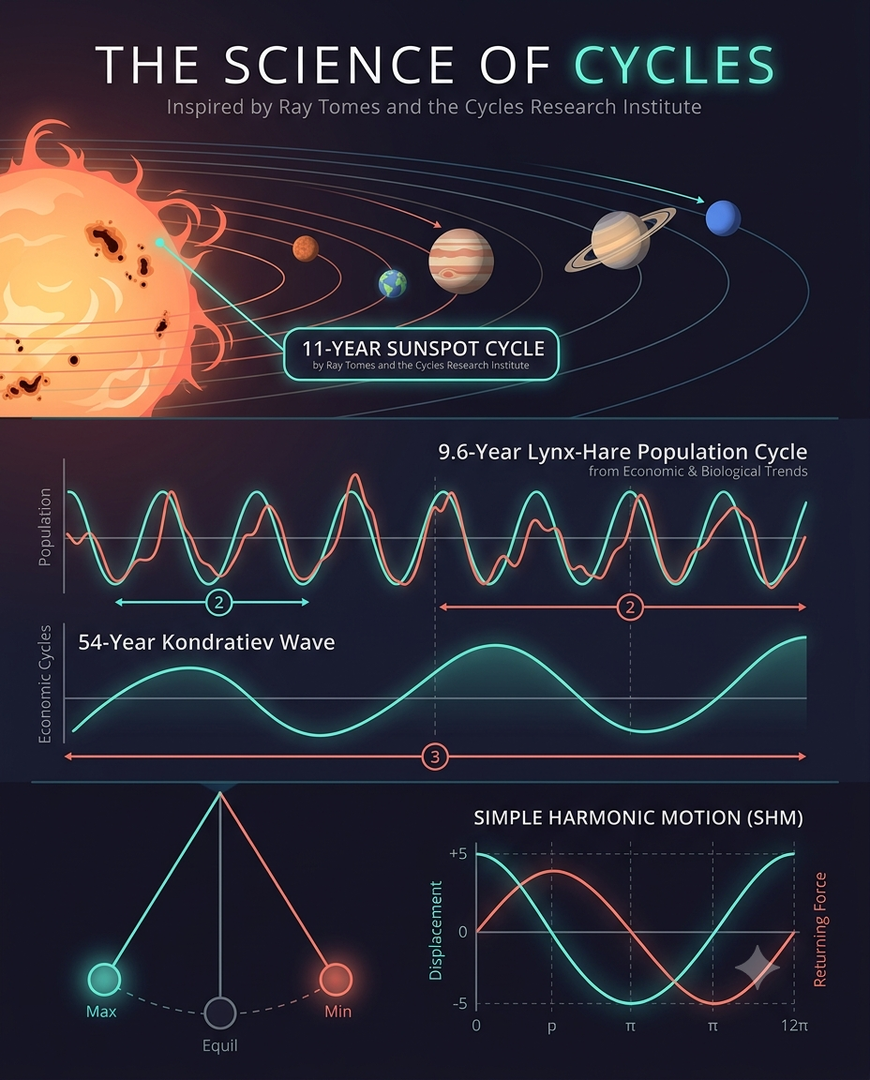
Core Concept & Mechanics: A cycle is a repetition of an event over a regular or semi-regular interval. Most cycles operate like simple harmonic motion (a swinging pendulum), where a displacement creates a force pulling the system back to equilibrium. Outside shocks may cause temporary disruptions, but systems naturally return to their baseline rhythm.
Astronomical & Climate Rhythms: Ancient civilizations like the builders of Stonehenge tracked solar and lunar cycles to predict eclipses. On massive timescales, Milankovitch cycles (23,000, 41,000, 100,000, and 400,000 years) alter Earth's orbit and tilt, driving ice ages.
Economic & Conflict Patterns: The ~50-year Kondratiev economic wave is driven by human demographic shifts during prosperous versus lean times. Additionally, the 11-year sunspot cycle (and its 22-year magnetic flip) correlates historically with peaks in military conflicts.
Biological Synchrony: A 9.6-year cycle triggers synchronized population booms and busts across species, including Canadian lynx, snowshoe rabbits, Atlantic salmon, and tent caterpillars.
Study of Cycles: Formed by Edward Dewey in 1941, the Foundation for the Study of Cycles cataloged thousands of cycles, discovering that many share simple mathematical harmonic ratios of 2 and 3. Dewey noted that studying any field without understanding cycles is like "the study of disease without the knowledge of germs".
- 💡 Would you like to create a study quiz or flashcards to test your knowledge on these cycles?
This topic was modified 4 weeks ago by RayTomes
Posted : 18/09/2026 5:31 am